2025
found object
30 x 80 x 25
Between 1987 and 1990, in Sri Lanka, detainees taken into custody did not return The state recorded them only as ‘disappeared.’ It is a misconception that what cannot be seen is something which does not, or did not, exist; that I remember… Time has worn off some detail, yet some memories remain deeply rooted, refusing the softening that happens over time. Glass Turned Steel not only evinces the physical endurance of memory; it also brings to light that state erasures leave a piercing echo behind, persisting as memories, still visible when light catches their sharp, jagged edges. Here, histories and ‘disappearances’ are made visible and tangible through the tactility and metaphorical potential of glass. Suppressed memories can pierce through the smooth veneer of official history. And by looking through this work, through the sharp translucence of glass, we see what the state once sought to render invisible. In this act of seeing, Glass Turned Steel becomes both memorial and defiance, an assertion that the disappeared persists in memory, light, and material form. (Text: Tia Madden) Made in collaboration with Bargo Men’s Shed (Peter Sutton and John Wooton) and with thanks to Lisa Barett. |
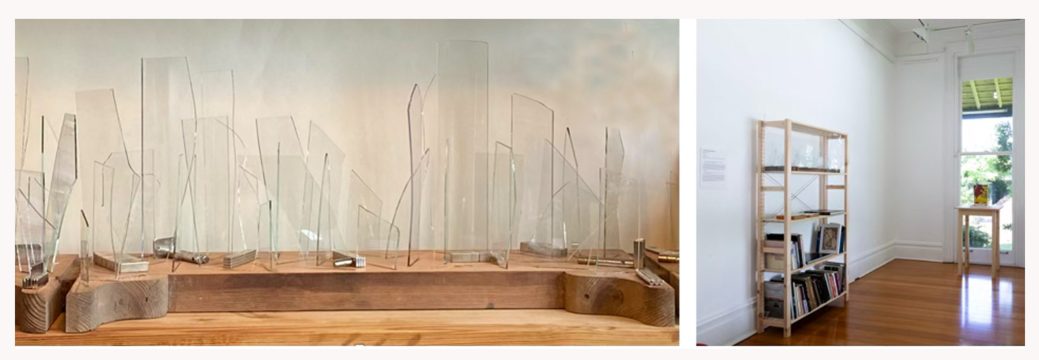 Jagath Dheerasekara, Glass Tuned Steel, Installation View, A River is a Witness, Penrith Regional Gallery, 2025. Photo: Silversalt Photography |